


For more than two centuries, a dam across the Rapidan River in Central Virginia was an economic imperative—a structural edifice that propelled manufacturing and commerce by altering the river’s flow.
But five years ago, the dam’s current stewards—the nonprofit American Climate Partners (ACP)—began considering the aging dam’s viability in the modern marketplace. After all, it had been nearly 60 years since the dam powered a milling operation in this rural community, and a more recent, 10-year hydropower effort proved financially unsuccessful.
With a mix of public and private partners, ACP launched the Rapidan Institute to lead a comprehensive river restoration study to evaluate the contemporary utility of the 88-year-old concrete dam and the potential environmental and economic benefits of altering it.

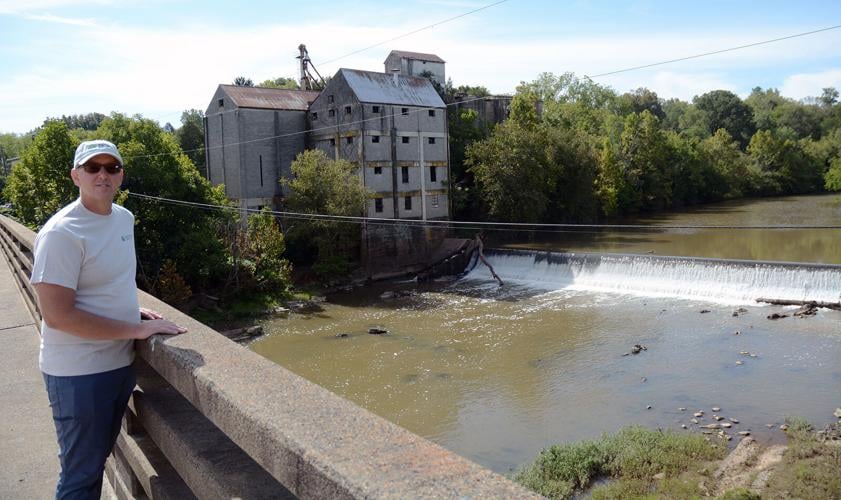
Dr. Shawn Young joined the Rapidan Institute this summer to lead the Rapidan Fish Passage Project. He holds a master’s and PhD in fisheries sciences from Clemson University and has more than 30 years of experience working with fish and aquatic organisms, aquatic ecology and habitat restoration. He is pictured here on the Rapidan River bridge midway between Orange and Culpeper counties in Central Virginia with the Rapidan Mill in the background.
In May, the National Oceanic and Atmospheric Administration (NOAA) announced a $7.9 million grant funding the results of that study: the Rapidan Fish Passage Project.
People are also reading…
The Rapidan project is one of more than 45 projects receiving nearly $240 million to reopen migratory pathways and restore access to healthy habitat for fish nationwide through the Bipartisan Infrastructure Law and Inflation Reduction Act.
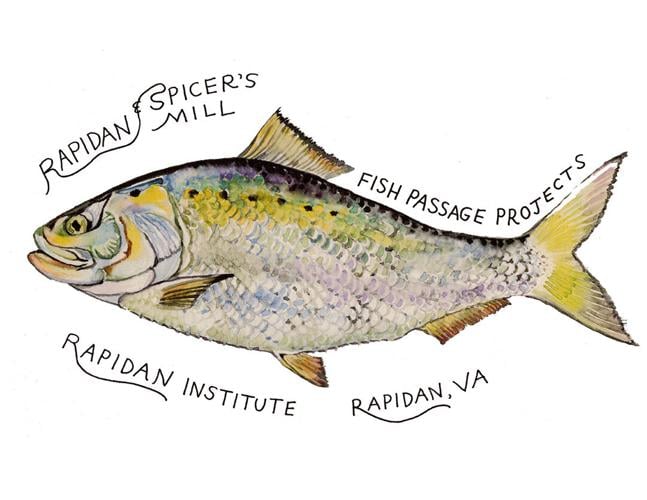
The project would remove all or part of the Rapidan Mill dam and restore habitat along the Rapidan River in the lower Chesapeake Bay watershed. Removing the dam would open more than 500 miles—and as many as 1,000 miles—of habitat for American shad, river herring and other migratory fish.

The Rapidan Fish Passage Project
“Rapidan, Orange County and Culpeper County are going to be ground-zero for restoration of the shad population in the Mid-Atlantic,” ACP Executive Director Michael Collins suggested. Before dams and river pollution, American shad were the most valuable and important fishery in the Chesapeake Bay and the Rapidan Mill dam has been identified as the top practicable dam removal project in the bay’s basin. “This is a project of national significance.”
Collins said the idea for the project originated in ACP’s popular and successful StreamSweepers program.
“StreamSweepers is a river remediation program and after you get a river cleaned up, the next question is, ‘What do you do to restore the wildlife and biology that are part of the river system?’ It didn’t take long to realize that dams are probably the single greatest impediment to the restoration of American shad in the Mid-Atlantic and so we began to ask ourselves, ‘how important is this dam to that fishery?’”
It’s not a new question. For more than 250 years, Rapidan-area residents and their upstream neighbors have weighed the benefits of damming the river for economic benefits against ecological advantage—so much so that colonial legislators even addressed the issue in 1759 noting that mill (and dam) owners needed to provide a fish passageway at least 10 feet wide over dams to provide access for migrating fish.
Over time, economic interests prevailed—which was good news for local farmers and merchants, but not for shad, which historically had been plentiful throughout the inland rivers and streams of the Mid-Atlantic.
The 11-foot high, 12-foot-deep and 200-foot wide concrete Rapidan Mill dam blocks migrating shad, river herring, striped bass, eels and other fish from native spawning and rearing grounds upstream. Specifically, American shad, hickory shad, alewife and blueback herring are migratory species that spend most of their lives in saltwater, but must return to freshwater to spawn. For the eels it’s all about free access to rearing habitat since they are spawned in the Sargasso Sea and then find their way into freshwater systems to grow for up to 20 years before returning to the ocean to complete their life cycle.
“A healthy river requires a healthy fishery and, by extension, a healthy Chesapeake Bay requires a healthy Rapidan River,” Collins notes.
The Rapidan meanders from its headwaters in the Blue Ridge Mountains through the Virginia Piedmont, connecting various streams, creeks and tributaries before emptying into the Rappahannock River west of Fredericksburg. The Rappahannock widens as it wanders eastward to the Chesapeake Bay.
“Shad are the foundation of the food chain in the Rapidan and essential to a healthy river and surrounding habitat. Removing the dam—or part of the dam—will open an area where these fish haven’t been able to go for more than 200 years,” Collins said.
Still, Collins, who has a background in historic preservation, appreciates the challenge of improving the river’s habitat and eco-system by altering a defining community characteristic.
“I don’t think those things have to be mutually exclusive. The fact that there’s been a mill and dam here for more than 200 years is not lost on us and, working with the Virginia Department of Historic Resources and a preservation consultant, we’ll do everything practicable and reasonable to preserve that history. It’s possible we may be able to save parts of the dam while creating the fish passage. That’s just one of many studies we’ll be doing over the next 12 to 18 months.”
The $7.9 million grant application divides the project into five phases over four years. During the first year, ACP and its contractor—Ecotone, LLC—will refine data, studies and analysis of site conditions, resources, opportunities and constraints in advance of project design. As part of the preliminary project studies, ACP will engage with adjacent landowners, stakeholders and the community through public outreach efforts. No demolition, construction or restoration will occur during the first year while studies are completed.
ACP also has partnered with the Virginia Department of Wildlife Resources (DWR) for assistance with preliminary work regarding sediment and fisheries sampling. DWR has been monitoring migrating fish in the Rappahannock River system for decades and will track the progress of migratory fish expansion once a free-flowing Rapidan River is restored.
The balance of the project—and the bulk of the funding—will be implementation of the approved design, including: site preparation and safety, dam removal, mill bank stabilization and riverbank stabilization and restoration (above and below the dam).
ACP already has taken the first substantial step in the project by appointing Dr. Shawn Young as Director of the Rapidan Institute and project lead.
For 30 years, Young has worked with varying agencies and academics, scientists and stakeholders on fish passage, aquaculture, environmental and habitat restoration projects. With a master’s degree and a doctorate in fisheries sciences from Clemson University, Young brings a background of applied research and field implementation to the Rapidan project.
Having spent his career working in habitat restoration and fish population restoration and recovery, Young has worked the last 13 years in the Pacific Northwest where communities weighed the effects of dam removal in favor of healthier salmon populations.
“Salmon is another fish of major historical importance that was in decline. Dam removal was very controversial for a long time, but people said, ‘we don’t want to lose these fish.’ Now, dam removals in that area are accelerating and there are instances where the salmon are migrating through the project areas almost simultaneously to crews tearing out the concrete.”
A similar experience closer to home has Rapidan Fish Passage Project organizers optimistic about the impact of the upcoming project. In 2004, when the Embrey Dam was removed from the Rappahannock River downstream from the Rapidan Mill dam, DWR fisheries’ biologists documented hundreds of Hickory Shad and even some American Shad migrating through the rubble even before the dam was completely removed.
That experience and other dam removal success stories throughout Virginia illustrate the opportunity for the Rapidan Fish Passage Project to develop a more modern balance between the natural and human coexistence in the area.
“The fish populations have been in decline for a long time, but they were historically critical to the survival of indigenous peoples, colonial settlers and early Americans. It was no accident people settled and lived here. American shad, striped bass, river herring, eels are important not only because they go out to the bay and are eaten by other fish, but also because they’re essential to the mussels and other amphibians and organisms in fresh water rivers and streams. Those other organisms have their own histories and strategies for survival that rely on the shad and other fish. Dams and other obstacles over the years have blocked that dynamic and are one of the leading causes for fish population declines.”
However, removing structures that no longer stimulate active economic activity can both improve the ecosystem and yield residual economic benefits through recreation, Young suggests. Whereas the dam once was an essential element in maximizing the economic impact of the river, removing it may be the modern equivalent. In that case, the natural and human worlds both benefit, he says.
“These structures, these places are historic. They’re part of the fabric of the community. We understand that and it’s important. Shad, stripers, herring, eel have also been part of that history. It’s difficult to say which is more important—the natural or human history—they’re both important and intertwined, but they’re starting to separate. These dams were vitally important in earlier times, but they’re not anymore. We need to change the paradigm of absolute and complete control of something to a more sustainable middle ground. Dam removal is an effective and affordable way to do that.”
Achieving that “middle ground” may be less quantifiable, but more intrinsically valuable.
“Professionally, we think this could make a huge difference. That’s why we’re pursuing it,” Young explains. “Everybody knows nature is not that healthy now. Fish populations have been declining and continue to decline. But just knowing that the rivers and the fish populations are healthy—even for those who don’t fish or eat fish—it helps to know that the fish are there and are healthier. It provides optimism. Removing the dam is a minor part, really, but add the benefit to the Rapidan and the Rappahannock and put it together with what folks are doing on the James, and the York rivers and the impact is significant on one of the most historically productive ecosystems in the world.”
For additional information on ACP and the Rapidan Fish Passage Project, visit americanclimatepartners.org or contact Dr. Shawn Young at shawn@americanclimatepartners.org.
ACP anticipates hosting its first community informational meeting on the project before the end of the calendar year.