


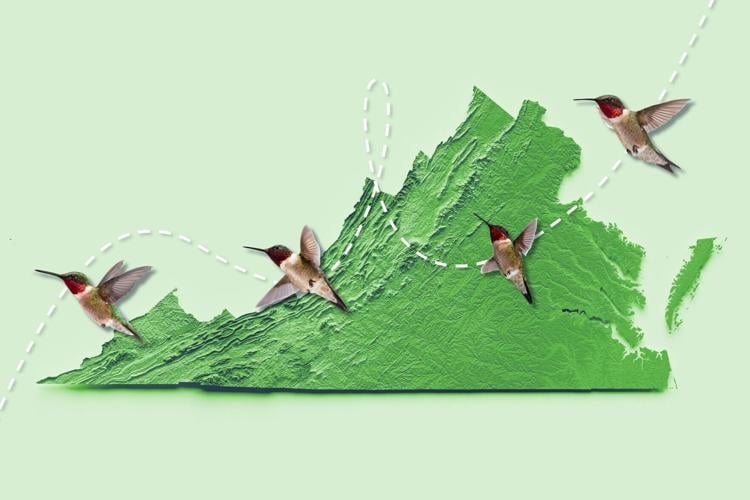


For more than a month, hummingbirds and other songbirds have been migrating through Virginia, stopping to feed along their way to Mexico and other Central American countries.
Avid birder David Carr, director of the University of Virginia’s Blandy Experimental Farm, a research institute near Winchester, spoke with UVA Today about how the birds accomplish this impressive journey and what people can do to help them on their way.
What migrations are crossing through Virginia now?
A. We are coming to the end of the first phase of the songbird migration period, which has been going on since late August or early September. These birds are neotropical migrants, flying south into Central and South America. They’re still moving through, but we’re sort of getting at the end of that train. We’re seeing the last of the hummingbirds, at least in our area up here in Clarke County. The last reported hummingbird sighting was on Oct. 3, but they are still being seen in the Charlottesville area.
People are also reading…
The birds that will continue migrating here into late October and November are coming from further north, from the Arctic and the boreal forest of Canada, and are going to stay in Virginia for the winter. (These include) yellow-bellied sapsuckers, several sparrow species and purple finches that are just starting to arrive.
What can you tell us about hummingbird migration?
A. We have only one hummingbird that breeds in the eastern United States: the ruby-throated hummingbird. You can be almost 100% assured that any hummingbird that you see in Virginia from late April through October is going to be a ruby-throated hummingbird.
To make the journey, they are capable of basically doubling their body weight in short order, so their metabolism really changes in the fall, right before migration. Hummingbirds have a very high metabolism and they’re voracious year-round, but it’s scaled up during migration. They just eat and eat, and most of the weight is stored as fat, which is a very efficient way to store energy in the body. These birds fly a long way, most of them going to Mexico or further into Central America, all the way down to about Panama.
It is pretty much a solo effort. You’ll see hummingbirds congregate at feeders, but the migration is usually more of an individual journey, which is true for most of the songbirds. You never see a migrating flock of hummingbirds.
How does the fall journey differ from the spring one?
A. They’re a little luckier on the way back to the tropics because it’s not quite the rush as it is in the spring. In the spring, they really want to hurry up to their breeding grounds as soon as possible to start finding mates and nest, so many of the ruby-throated hummingbirds amazingly launch from the Yucatan Peninsula and fly over the Gulf of Mexico to the Gulf Coast in one day.
But the pace can be a little more leisurely on the way south, so that helps, energetically speaking. During the fall, they tend to funnel into Mexico along the U.S. Gulf Coast, working their way down more toward Louisiana and Texas, so there are always potential places to stop.
How can people support migrating hummingbirds?
A. Well, before there were feeders, hummingbirds mostly fed on nectar from flowers. There are a lot of Virginia native flowers people can plant that hummingbirds will (drink from). The trumpet honeysuckle and trumpet creepers are two good ones that bloom in the late summer and early fall. But, as long as you keep them clean, feeders are a great help to hummingbirds, too.


