


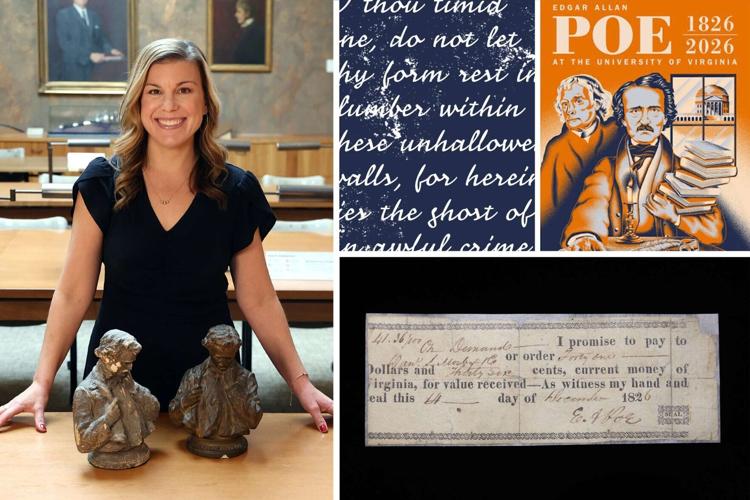
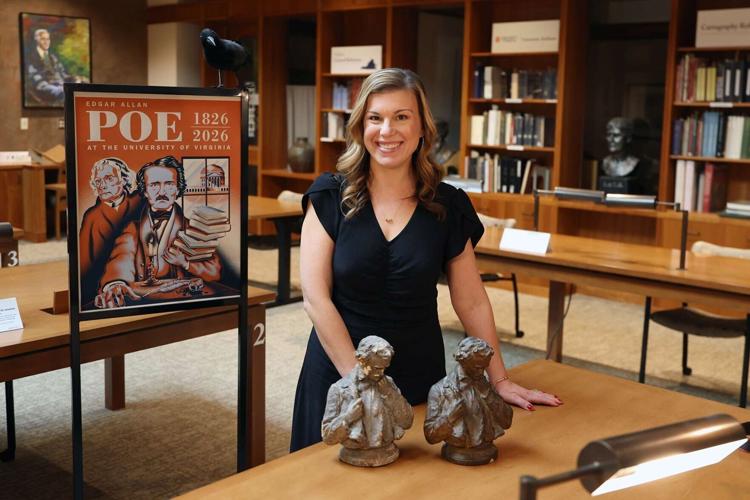

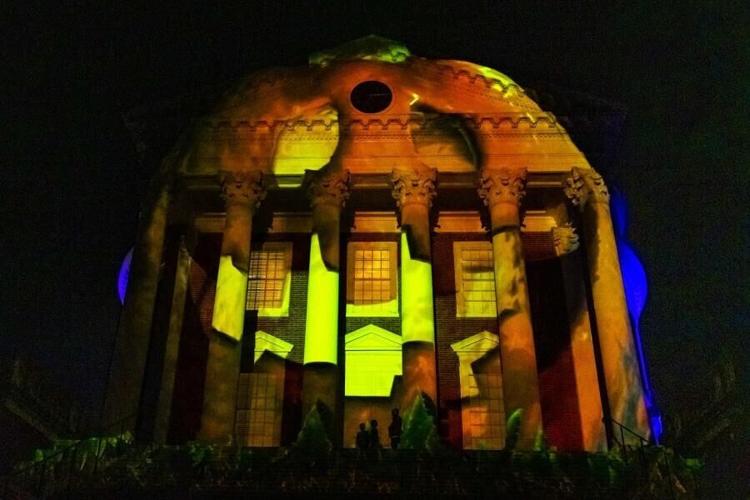
Cristina Richieri Griffin, a UVA English professor, says Poe was a rambunctious student before he became a well-known writer.
The University of Virginia was only home to the poet and writer Edgar Allan Poe for 10 months. A new exhibition at UVA’s Albert and Shirley Small Special Collections Library explores the pioneer of the detective novel’s time on Grounds and the lasting influence it had on him.
“Poe lived many different lives in many different places, and each place likes to claim its own Poe. This is our Poe – Poe at UVA. Poe during the first 10 months of his adulthood. Poe on the cusp of his literary greatness,” said Cristina Richieri Griffin, an assistant professor of English and a co-chief curator of “Edgar Allan Poe at UVA: 1826 | 2026.”
Those other Poe places include Boston, Philadelphia, New York City, Baltimore, Richmond and, of course, Charlottesville. The exhibition, on view at Special Collections now through April 9, celebrates the 200th anniversary of Poe’s time at UVA. Griffin and Annie Persons, a lead advising fellow in the College and Graduate School of Arts & Sciences, curated the exhibition, which includes everything from a matriculation book listing Poe as the 136th of 177 students to enroll in 1826 to a windowpane believed to depict a poem Poe wrote as a student. The exhibition is part of a larger “Poe at UVA” initiative presented by the UVA Reading Collaborative and supported by a National Endowment for the Arts grant that Griffin and Kirsten Gelsdorf, a professor in the Frank Batten School of Leadership and Public Policy, received.
People are also reading…
When Poe started at UVA, on Valentine’s Day in 1826, he lived on the Lawn. Before his 10 months were up, he moved into a room on the West Range, believed to be Room 13. He was given to some light vandalism.
“One of my favorite stories about Poe is that in his dorm room, he loved to draw on the walls, much like students today decorate the Beta Bridge, put signs and drawings outside of their rooms on the Lawn,” Griffin said.
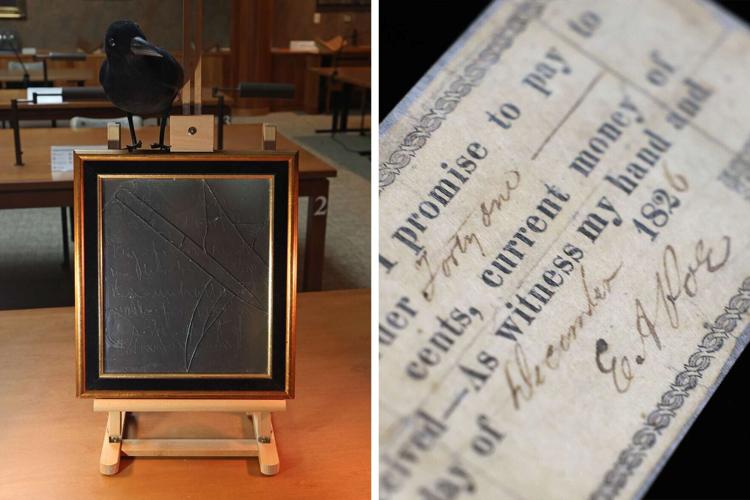
Some Poe experts – Griffin included – believe Poe etched a few lines of verse on a windowpane from Room 13:
“O Thou timid one, do not let
Thy form rest in slumber within these
Unhallowed walls,
For herein lies
The ghost of an awful crime.”
“If we place this windowpane in the context of his dorm room drawing and drafting, this windowpane etching makes a lot of sense,” Griffin said. “I personally am convinced that this very well could be the work of Poe’s mind and hand.”
Transcript
At some point in the last 200 years, the windowpane shattered and was pieced back together. One piece, running from the upper-left corner to the lower-right corner, forms the shape of a dagger, a fitting detail for one of the founders of the detective genre.
On Dec. 14, 1826, one day before Poe left Grounds, he issued a promissory note – essentially, an IOU, which is included in the exhibition – to someone named William S. Moseby for $41. In today’s currency, that would be about $1,400. There’s no evidence Poe ever settled his debt to Moseby, and Poe would never return to the University.
Curators at Special Collections believe the note has not been exhibited before, likely because scholars dismissed Poe’s education at UVA as too brief.
“But you ask any first-year if their 10 months on Grounds has felt short and unimportant, they would absolutely tell you no,” Griffin said.
The note also makes it clear that Poe only left UVA for financial reasons. Poe’s foster father, John Allan, paid for two courses Poe took, one in the School of Ancient Languages, the other in the School of Modern Languages. But the polymath Poe wanted to take a course in the School of Mathematics, which Allan refused to cover.
What Poe called his “dissipation” was worsened by his gambling habit.
“He was, like many of his classmates, rambunctious, to say the least. He excelled in his classes. He was part of clubs. He was the secretary of the Jefferson Literary Society, and he also had a penchant for drinking and gambling,” Griffin said.
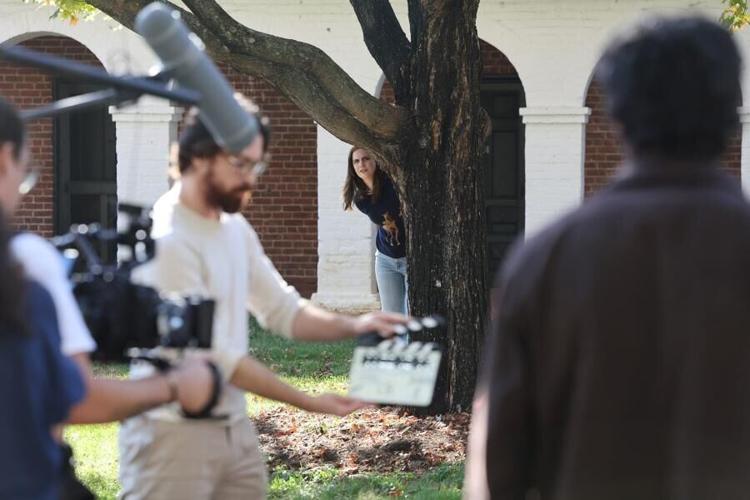
Transcript
What he bet on, however, was unusual. He became obsessed with a book of prints by the English artist William Hogarth. One of Poe’s peers was likewise enamored with the book, so Poe invited him to gamble for who would possess the book. He lost the bet, but was able to keep the book so long as he paid for it.
“He was engaged in activities that were not part of the Jefferson-prescribed activities of students,” Griffin said. “He was gambling for art, which I think is wonderful.”
Media contacts
University news associate
Office of University Communications
434-924-6861


