




Ken Melville didn’t intend to buy a winery when he attended the auction of the land where the tasting room for the former Autumn Hill Vineyards is situated in Dyke. He was one of the few bidders at the site off Bingham Mountain Road. He just wanted to check it out since it is near his home.
“I placed my bid shaking so much, I couldn’t even sign the paperwork,” Melville recently remembered. But it wasn’t until he purchased the place that the dream began to take shape.
Melville, one of 10 children, had considered operating a farm brewery at the site, but knew financially he was at his limits. That’s where some of his siblings came in.
There are five daughters and five sons in the Melville family, so he invited his brothers and sisters to Greene County for a bus tour of the site.
“He said, ‘Are you interested in investing?’ We saw that he had the winery building and six acres, but there weren’t any vines, so we said we weren’t that interested,” Joan Melville-Kohls said. “Ken was keeping the place and we told them if they ever sell the house with the vineyard to let us know.”
People are also reading…
Well, the Kohlses received a call in 2019 that Ed Schwab was ready to sell the main house and property with the vines.
“Richard and I came up here; we talked to Ed Schwab,” Melville-Kohls said. “He’s one of the early pioneers for vineyards here and he’s responsible for getting Greene County in the Monticello wine region. He had to prove that Thomas Jefferson had related business in Greene County and he got that done. He was a powerhouse.”
Unfortunately, by that time, Schwab was in his mid-80s and unable to continue the upkeep on the vines or structures.
“Richard and I came in the house and we talked with a neighbor,” Melville-Kohls said. “And then we went over and looked out that window and as we did, Richard said, ‘Well, Joan, you’ve always wanted to live in the mountains. And I’d like to make wine’.”
Kohls himself remembers the moment a bit differently, though.
“Actually, I said, you want to make wine,” he laughed.
“I was just ecstatic that he wanted to do this,” Melville-Kohls said.
Once they were on board, sister Anne Costain with husband Ron got on board, too. And the families created Foothills LLC for their new Foothills Winery.
Since then the family members have worked together to rebuild the sites.
Virginia Wine
Autumn Hills Vineyards, off River Road in Dyke, was started in 1979 by the Schwab family from New York. The first vintage was produced in 1986 and the most recent award-winning batch was from 2006. Over the years, Ed Schwab earned numerous awards for his wines.
Virginia has cultivated a reputation of high-quality wine making over the past nearly 50 years, from the start of its modern journey with Barboursville Vineyards in Orange County, which was founded in 1976 by Italian winemaker Gianni Zonin along with his vineyard manager Gabriele Rausse. There are now more than 300 vineyards in Virginia.
However, the history of wine in Virginia goes back to 1619 with the House of Burgesses’ “Acte 12,” which required every male head of household in Virginia to plant 10 vines of imported vinifera grapes for every acre of property. One of the region’s neighbors—Thomas Jefferson—gave 2,000 acres of land adjacent to his home in Albemarle County to Filippo Mazzei, an Italian viticulturist, to plant vinifera vines. He didn’t have much success then, but the grounds where they once stood are now named Jefferson Vineyards.
In a letter dated Feb. 20, 1980, Virginia Cooperative Extension Fruit Specialist E.L. Phillips had this to say about the location the Schwabs had chosen:
“Relative to our telephone conversation this morning concerning the vineyard site of Mr. Ed Schwab, I believe it to be one of the better sites anywhere in the state of Virginia. Grapes are very particular about both site and soil upon which best production can be achieved and this site appears to have all the necessary requirements. Few sites in this area of Virginia are of comparable size and quality.”
Autumn Hills was the first vineyard in Greene County, with Stone Mountain in Dyke beginning in the mid-1980s. The owners of Kilaurwen Winery off Evergreen Church Road began crafting their own wines in 2009 and have grown grapes since 1994. There are other nearby wineries, but those are the only three within Greene’s boundaries.
Ava and Ed Schwab would later say their Virginia wines had a “European accent.” Eventually, the plantings grew to about 13 acres of Chardonnay, Viognier, Cabernet Sauvignon, Cabernet Franc, Petit Verdot, Malbec and Nebbiolo vines.
According to Greene County Record archives, Autumn Hill Vineyards opened officially on May 2, 1987, with one visiting taster.
When the Kohlses met Schwab, he noted they weren’t scared.
“He looked at us seriously and said, ‘You guys aren’t afraid’,” Melville-Kohls remembers. “We’re not afraid of this. It just felt right.”
Schwab passed away in 2020 at the age of 88, and by the time the Kohlses purchased the property, pine trees had grown all around and in the pool; the vines were left untouched for years and the tasting room needed serious work.
Foothills
The Foothills Vineyard team has spent the past couple of years rebuilding—the land, the vines, the hops and the buildings—and learning as much as possible through Piedmont Virginia Community College and other nearby resources.
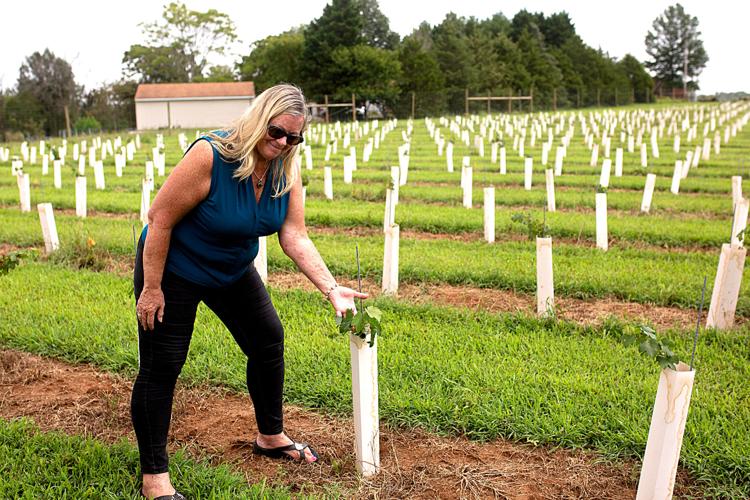
“We decided that we would take just five acres at a time and go slow,” Melville-Kohls said. “We tore this down. This was five acres full of vines on trellises. This field had never been planted and we did all that ourselves except the plants themselves, and we put a fence around the vineyard.”
Working with a consultant and having soil testing done, they have planted six different grape varieties. White grapes include Albariño and Chardonnay. Reds include: Cabernet Franc; Cabernet Sauvignon; Petite Verdot; and Merlot.
“We put about 5,880 plants in; we’re supposed to get more but they didn’t have all that we needed,” Melville-Kohls said. “We had a great planting experience. We had only about 28 plants that died that first year.”
Grapes are susceptible to frosts and the way the land is situated on a plateau, the plants go downhill.
“The colder air sinks to the bottom,” Ron Costain said.
Melville-Kohls said there’s a light breeze that seems to come through the vineyards all the time.
“It just kisses the top of the hills and grapes need air because mildew is one of the biggest problems in growing grapes,” she said. “That constant little breeze keeps us from freezing.”
“We probably won’t plant all the acres behind because the drop off is really sharp,” Kohls said. “We’re going to probably put some hops in down there so (Ken) will have some hops for his beer.”
Melville has been working on his beer-making processes and when the tasting room is re-opened it will have his beer and their wine, but Costain said the goal is to remain small.
“We all have day jobs,” Melville-Kohls said. “One of my dreams—I know Richard says no, but I might get my way— is to host a farm-to-table night overlooking that big beautiful mountain view.”
Brewery
The acreage surrounding the old Autumn Hills tasting room was purchased first by Melville.
“We just cleaned everything out. There were a lot of trees and a lot of poison ivy,” Melville said. “This roof was collapsing so I put a new roof on. There were a lot of cosmetics to be done on the building. My brothers and I just got down below and replaced some of the rafters and replaced some of the siding. I was just trying to figure out what to do with it. What I love about Greene County is you can go talk to the county supervisor or you can talk to somebody else and say you just bought Ed Shwab’s old place and they know where it is.”
As you enter Melville’s beer-making laboratory you see a photo from Prohibition-era America with protestors carrying signs that say, “We want beer!” For Melville that sums up why he’s interested in brewing: “Well, I like beer,” he laughs.
And he’s learned a lot since he started the adventure. He grows his hops in pots right now, but intends to begin deeper root systems for his plants.
When his sisters were willing to come along and create the wine to go with his beer, Melville was excited.
“Our business plan is totally changed now, but in the meantime I was making some beer and having a lot of fun with it,” he said. “When you hear a nice papery sound in your fingers, the hops are ready to harvest. You can’t let it go too far; they’ll dry up quick.”
There are also different varieties when it comes to the hops, Melville said, and some have different aromas. He notes he’s still learning himself.
“I love the fact that this property has this history,” Melville said. “When we say it’s the Autumn Hill property, people know. Schwab had a good following and the tradition of putting out some award-winning wines. I think it’s just got great character.”
Melville-Kohls agreed.
“I think it’s amazing we can do this,” she said. “Ed made award-winning grapes before and we will again.”


