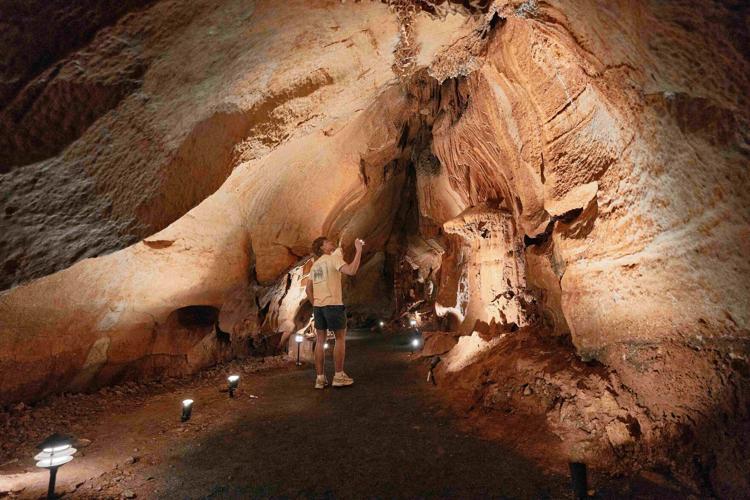



The moment you step through the entrance of Grand Caverns in Grottoes, you can feel a change in the air.
It may be summertime muggy outside, but a few paces into the historic Shenandoah Valley cave, the temperature plummets to a cool 54 degrees. Minutes later, you’re surrounded by ancient, otherworldly rock formations that began forming millions of years ago.
“You see things in caves that you don’t see anywhere else on earth,” says Mike Smith, a cave lover who stopped for a tour of Grand Caverns while driving between Florida and Pennsylvania. “There’s always something different in each one.”
In an age of XBox and theme parks, visiting a cave may seem quaint and old-fashioned. And, truth be told, it is. People have been oohing and aahing at cave formations for centuries. “This is nature and the outdoors in a different way,” says Lily Whitman, parks coordinator for the Town of Grottoes, which owns Grand Caverns.
People are also reading…
People have always had a fascination with caves, says Ángel Garcia, a geology professor at James Madison University. In his native Dominican Republic, a cave is central to the native Taíno people’s creation myth. To say you’ve known someone a long time, Dominicans say they’ve known them from the time of the guacara (“cave” in Taíno).
These days, a trip to one of the Valley’s caves also provides something most of us crave in this digital age: time offline. Since cell phone signals can’t reach through hundreds of feet of solid rock, the only distractions in a cave are the beauty and wonder around you. (Seriously, though, put your cell phone on airplane mode when you enter a cave or the battery will be dead by the time you leave. Experience is speaking here.)
But exploring a cave is about more than cooling off in the summer or taking a break from your notifications. “It’s the lure of the unknown,” says Rick Lambert, a retired Highland County electrical contractor who has spent decades finding and exploring caves. “Those of us who love caves see each one as different. No two formations are the same.”

Every cave tour has its moment when the guide explains how caves work, so this will be ours.
Five hundred million years ago, what’s now the Shenandoah Valley was a tropical coastal plain that collected layer upon layer of sand and shelled sea creatures. Over time, those layers compacted into sandstone and limestone. Colliding continents shoved the coastal zone many miles inland and formed the mountains and valleys of Western Virginia.
The Shenandoah Valley’s deep layer of limestone, also known as karst, was the perfect place for making caves. The Valley’s caves are growing and changing today. Rain percolates through the soil, carrying miniscule bits of carbonic acid through fissures in the limestone. The acid dissolves the rock, redepositing it in the cave as the water drips from the ceiling, splats on the floor, or fills still pools.
The redeposited rock, known as flowstone, takes an endless variety of shapes. The most well-known of those are stalactites, which hang from the ceiling, and stalagmites, which build up from the floor. But flowstone also forms translucent draperies, sunflower-like shields, pebbly pieces that resemble popcorn, and delicate starburst-looking anthodites.
The interplay of light and shadow in a cave turns those formations into dinosaurs, desert scenes, or pretty much anything a visitor can imagine.
Considering that it takes 120 years to form a single cubic inch of flow stone, the time needed to fill a cave with massive columns and acres of amazing formations is mind-blowingly long. A single formation in Grand Caverns, for example, is estimated to be 500,000 years old.
The country’s oldest show cave, Grand Caverns was discovered in 1804 by Bernard Weyer, the namesake of nearby Weyers Cave. Weyer knew he had found something special under the hill in the northeast corner of Augusta County. By 1806, he was giving tours.
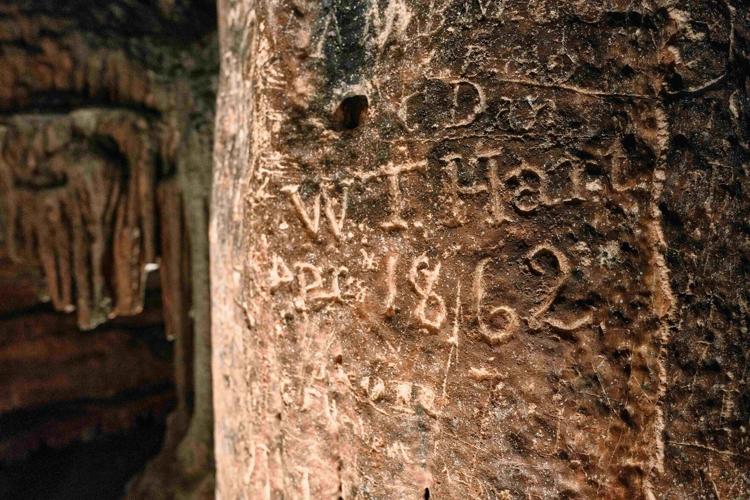
In the years that followed, Thomas Jefferson drew the first map of Grand Caverns. During the Civil War, both Union and Confederate soldiers visited the cave during breaks in the fighting and left their signatures on the walls.
Throughout the 19th century, the local community held candlelight dances and other social events in the cave during the summer to escape the heat. Last year, Grand Caverns renewed that tradition by hosting bands and movie nights in the heart of the cave.
As Grand Caverns prepared to celebrate its bicentennial in 2004, researchers discovered an entirely new 2-mile section of the cave that more than doubled its known size. That section remains off-limits to the public.
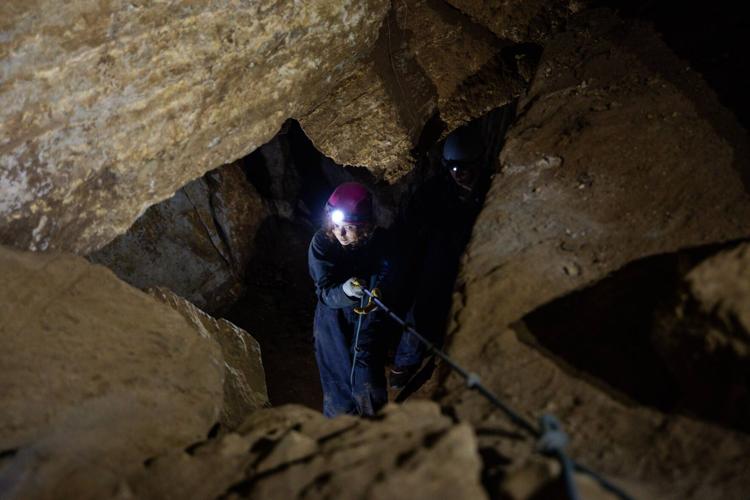
If that last sentence has you itching to strap on a hard hat and wriggle through some underground passages, you’re a good candidate for one of Grand Caverns’ adventure tours that take visitors off the beaten path to explore the cave up close like Weyer himself. The really adventurous can tour largely undeveloped Fountain Cave nearby.
“Nowadays it’s really hard to create your own adventure,” Whitman says. “With adventure tours, you get the people who are really into it.”
For the less adventurous, the Valley offers tamer tours like those at Luray Caverns, where a new entrance that opened in 2019 bypasses more than 70 steps visitors used to have to tread into and out of the cave. The new entrance, combined with historic brick footpaths, makes the caverns accessible to anyone with mobility issues.
(Full disclosure: I was a guide at Luray Caverns back in the 1980s. Visitors now explore the cave at their own pace with a self-guided tour.)
“There’s something deeply grounding about stepping into a place that’s been forming for millions of years,” says Bill Huffman, Luray Caverns’ marketing director. “Visitors often tell us that Luray Caverns offers a rare sense of awe and wonder, a chance to slow down and reconnect with the natural world. It’s a shared experience that spans generations.”
Each year, 500,000 people travel the 1.5-mile brick path that winds in a figure eight from the Fish Market and Mirror Lake past Titania’s Veil and Pluto’s Ghost and through Skeleton Gorge — where explorers found an actual human skeleton in the late 1800s. In the Cathedral, visitors experience something they don’t find in any other cave: music.
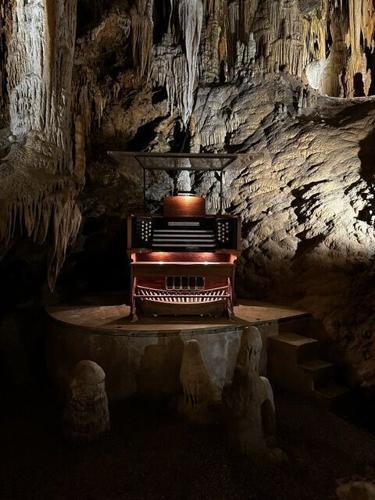
That’s because Luray’s most famous feature is the Great Stalacpipe Organ, which uses the cave’s formations to play a haunting version of “Oh Shenandoah.” The organ’s inventor, Leland Sprinkle, was inspired to develop the sprawling instrument when a tour guide in the 1950s showed how stalactites resonated when struck with a mallet.

Soon after, Sprinkle began a three-year project to tune specific formations, often shaving them down until they played the note he wanted. Electric hammers wired to the organ console strike the formations at the press of an organ key. Covering 3.5 acres, the Great Stalacpipe Organ is recognized by Guinness World Records as the largest natural underground musical instrument.
These days, the rule for visiting Virginia’s caves is strictly “hands off.” The little bit of oil on your skin is enough to stop an active cave formation’s growth dead in its tracks. Protection and preservation are the priorities.
That was not always the case, of course. Any cave tour will reveal plenty of places where previous visitors broke off bits to take home as souvenirs. In caves that are still active — where water still drips and flowstone still forms — that damage will repair itself in time, give or take a few millennia.

Melrose Caverns near Harrisonburg celebrates its human history in the form of graffiti left behind by soldiers during the Civil War. Union troops used Melrose Caverns as a base of operations during the Valley Campaign of 1862. The army stored ammunition and food in the cave, and 200 soldiers lived there. Bored soldiers from Indiana and Ohio drew on the walls with charcoal or carved their names and unit numbers into the surface of the formations.

“There are hundreds of stories in here to be told,” Jim Yancey says. Yancey is the 10th generation of the same family to own Melrose Caverns, which sits on land the original owner, John Harrison, received as a land grant from King George III in the 1700s. Harrison lent his name to nearby Harrisonburg.
Melrose Caverns reopened in 2020 after being closed for nearly 60 years. Family members are working with the Smithsonian Institution to document the history of the cave while also opening it for weddings and events like the Cave Comedy Fest in July.
“This belongs to our family, and it’s our duty to preserve, protect, and share it with people because it’s a piece of history that people deserve to understand,” says Jack Yancey, Jim’s cousin and a member of the family’s 11th generation.
For Jim Yancey, a visit to the Shenandoah Valley’s caves is about more than fantastical formations and human habitation. “We’re walking through time,” he says.
Shenandoah Valley show caves
It’s easy to join the underground society of cave visitors by dropping in at any of the Shenandoah Valley’s famous show caves.
Endless Caverns, New Market
Claim to fame: Gets its name because it has many miles of tunnels yet to be explored.
Grand Caverns, Grottoes
Claim to fame: Shield formations and Civil War artifacts
Luray Caverns, Luray
Claim to fame: The Great Stalacpipe Organ, fried egg formations
Shenandoah Caverns, Quicksburg
Claim to fame: Rainbow Lake, the only Valley cave with an elevator
Skyline Caverns, Front Royal
Claim to fame: Crystalline anthodite formations and 37-foot Rainbow waterfall
Travel the Karst Trail
The Virginia Department of Conservation and Recreation and the Virginia Cave Board have created the Virginia Cave and Karst Trail to showcase the unique system of caves and surface features found throughout the Commonwealth’s western valley system. Learn more.