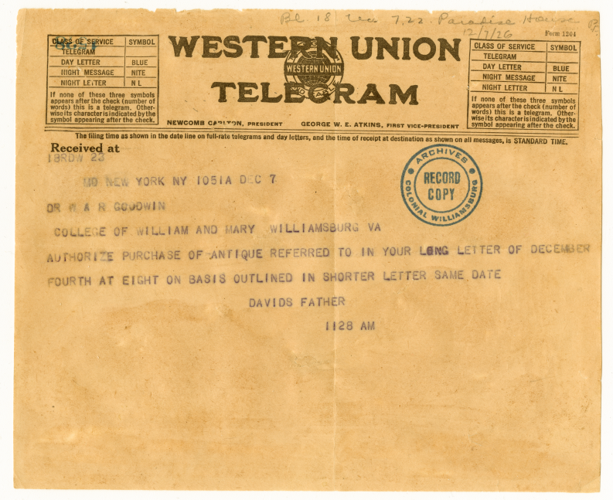


The Western Union telegram that arrived in Williamsburg appeared at face value to be inconsequential, shrouded as it was in vague references:
AUTHORIZE PURCHASE OF ANTIQUE REFERRED TO IN YOUR LONG LETTER OF DECEMBER FOURTH AT EIGHT ON BASIS OUTLINED IN SHORTER LETTER SAME DATE
The sender’s identity — DAVIDS FATHER — was enigmatic, and for good reason. This was no ordinary message, and its request no simple transaction. The telegram, sent in December 1926, sparked a revolution: the unprecedented effort to turn back the clock on an entire Virginia town.

A 1926 telegram from Rockefeller authorized the first of scores of buildings the business magnate and philanthropist eventually purchased in Williamsburg.
A century later, Colonial Williamsburg is the world’s largest living history museum. Throughout 2026 — a year that marks its 100th anniversary and is also coincidentally the United States’ semiquincentennial — Colonial Williamsburg will be celebrating these remarkable milestones while looking toward the future. The museum remains a work in progress, always expanding its programming for the countless families, history buffs, and dignitaries who descend on the noble, old town. As life irreversibly migrates onto digital platforms, Colonial Williamsburg is leveraging its distinctive properties to play a major role in a new era of connected human knowledge.
People are also reading…

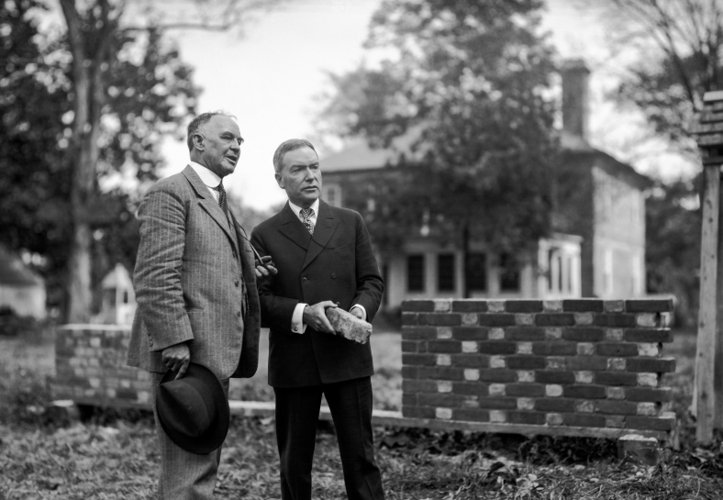
W.A.R. Goodwin, left, and John D. Rockefeller Jr. hatched a radical plan to restore an entire Virginia town.
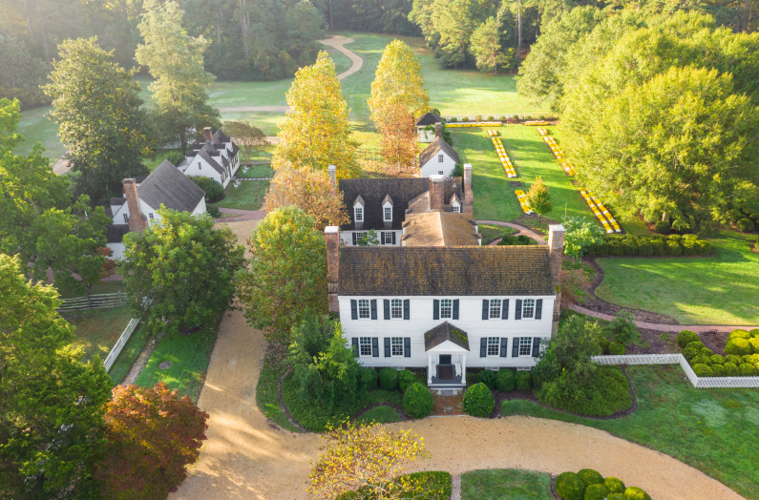
W.A.R. Goodwin was the rector of Williamsburg’s Bruton Parish Episcopal Church and the recipient of the 1926 telegram. He had been lobbying for the restoration of Williamsburg, by then a sleepy southern hamlet, to its 18th century appearance, and found a benefactor in business tycoon John D. Rockefeller Jr. — a.k.a., David’s Father — who, along with his wife Abby Aldrich Rockefeller, provided the funds to bring old Williamsburg back to life. The “antique” that Rockefeller mentioned was the Paradise House, the first of scores of historic buildings he eventually purchased.
Over the next several decades, a lot changed in Williamsburg. Rockefeller acquired upward of 140 properties, spending tens of millions of dollars. Teams restored 88 original buildings to their 18th century appearance and reconstructed many more, among them the Capitol and Governor’s Palace, the imposing symbol of royal authority in colonial Virginia.
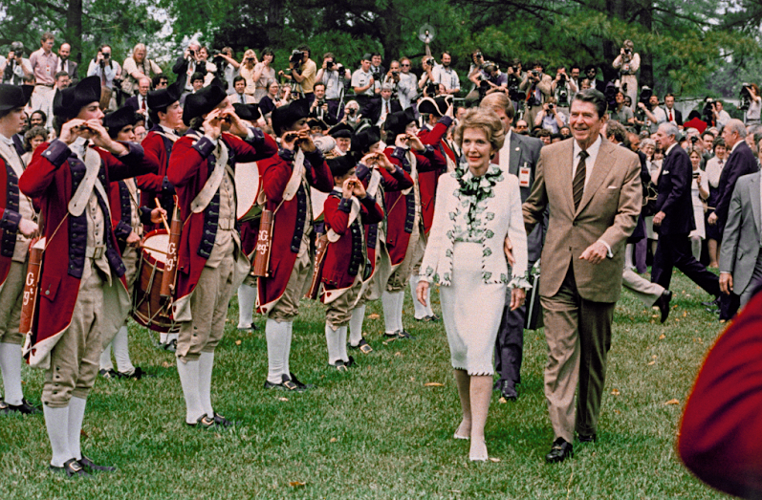
Alongside the physical restoration, the Colonial Williamsburg Foundation brought on historical interpreters. The five-star Williamsburg Inn opened its doors, as did the Abby Aldrich Rockefeller Folk Art Museum, with Mrs. Rockefeller’s personal collection seeding its debut. The Fifes & Drums of Colonial Williamsburg provided a rousing, live soundtrack for this extraordinary experiment in public history.

President Ronald Reagan and First Lady Nancy Reagan welcoming Queen Beatrix of the Netherlands to the White House South Lawn in 1982 as the Fifes and Drums of Colonial Williamsburg perform
The focus of programming in those first decades, according to Colonial Williamsburg’s Chief Mission Officer Ron Hurst, centered on the revered names who achieved mythic status in U.S. history — George Washington, Thomas Jefferson, and Patrick Henry, for instance. The colonial architecture and historic trades, such as the blacksmith and weaver, were also cornerstones of early historical interpretation.
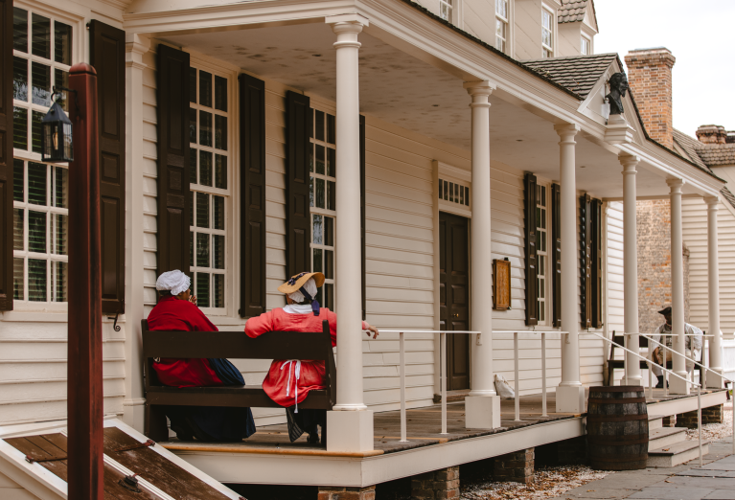
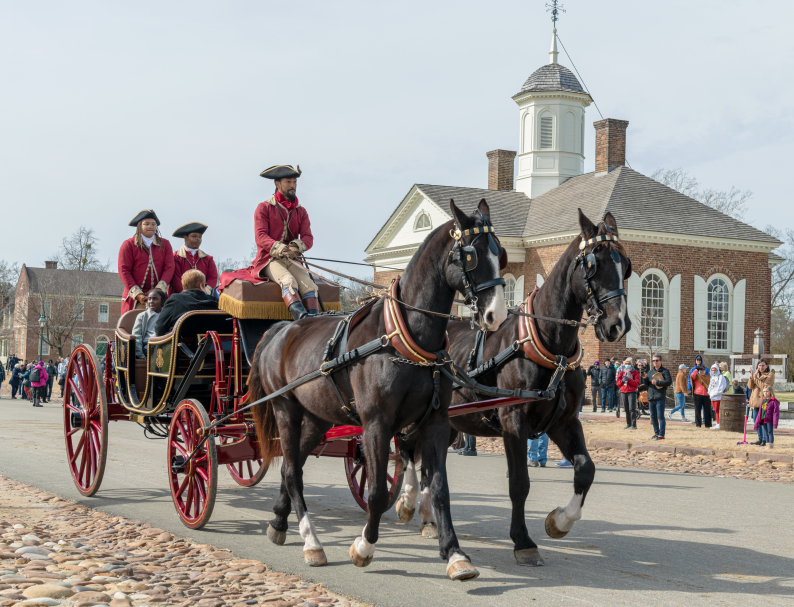
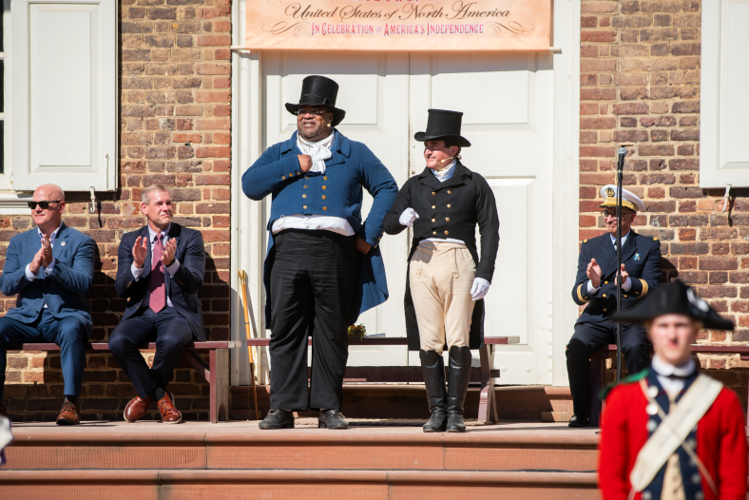
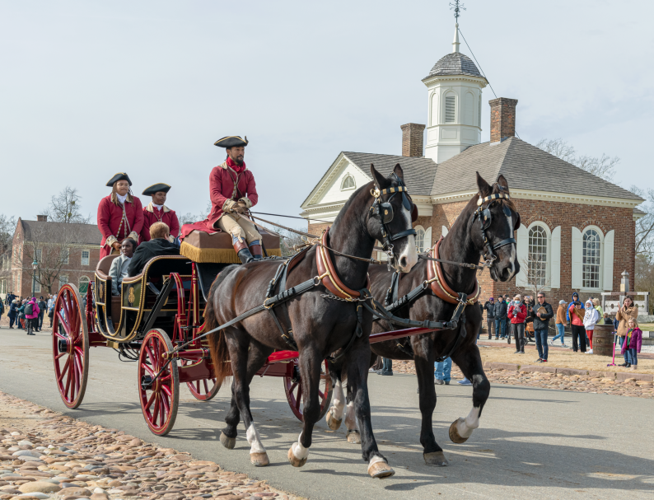
That original vision remains. Today, Colonial Williamsburg, the anchor of Virginia’s Historic Triangle, offers a distinctive window to the past, an experience that’s as close to time travel as you can get. Visitors can immerse themselves in an 18th-century town on the cusp of war, meandering bustling streets alongside horse-drawn carriages and historical personalities, or dining in a historic tavern, all while the thunder and shrill of fife and drum music blankets the 301-acre Historic Area.
But much has changed through the years, too. As scholarly horizons have expanded, so has the way Colonial Williamsburg approaches and presents history. “Today we work toward a far more complete picture of the town as it was on the eve of revolution,” Hurst says.
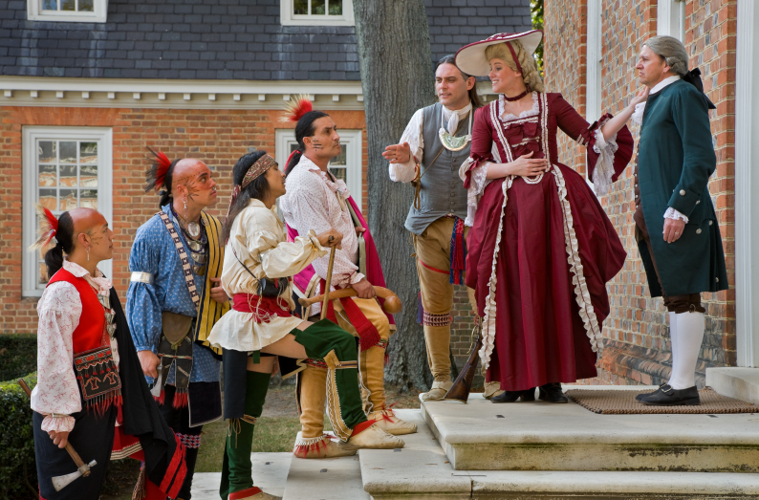
For instance, 51% of 18th-century Williamsburg’s inhabitants were free and enslaved people of color. The museum has expanded programming to reflect that reality and incorporated perspectives of other groups such as women and American Indians, whose stories are equally essential to understanding the birth of the modern United States.

“One of the things that makes Colonial Williamsburg special is that we are one of the few places that can tell the story of an entire town,” Hurst says. “Our aim is to give a full picture of the place where so many ideas were born and advanced. Our approach is to tell what happened — the good and the bad — but we will not tell anyone what to think.”
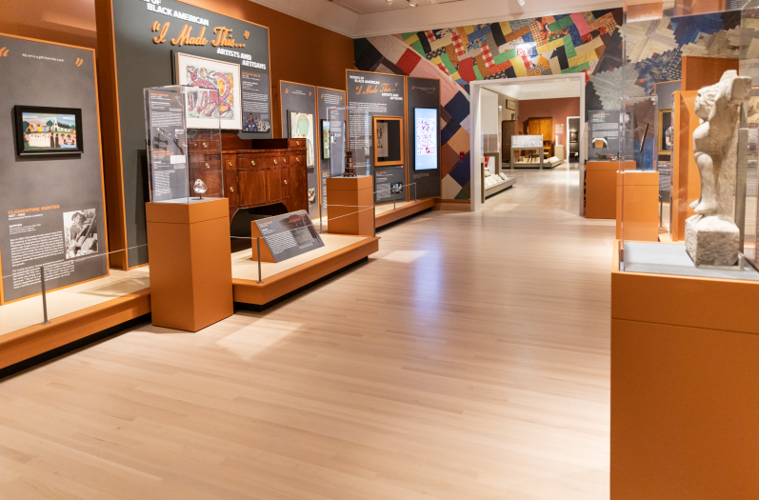
These snapshots of the past come to life in the painstakingly curated Historic Area, but they’re found, too, in Colonial Williamsburg’s extensive museum collections, more than 85,000 items in storage and on display — objects made by people from the past that reach across time to tell stories of long ago.
In 2026, the institution will commemorate its century of existence in The Art Museums of Colonial Williamsburg. An exhibition called “Colonial Williamsburg: The First 100 Years,” opening in February, will honor the town’s history, exploring the period between its revolutionary heyday and 1926, detailing the massive effort to restore the town, and looking forward to the next 100 years. Colonial Williamsburg will also be publishing a volume, available by mid-year, called “That the Future May Learn from the Past: The First 100 Years of Colonial Williamsburg,” by Paul Aron. The book chronicles the long evolution in how history has been presented in Virginia’s colonial capital.

Throughout the year, Colonial Williamsburg will be staging events that not only mark its centennial but also the 250th anniversary of the signing of the Declaration of Independence, including special programming in summer around Independence Day. In October, Virginia’s General Assembly — the oldest lawmaking body in the Western Hemisphere — will convene in Williamsburg, where 250 years ago their predecessors fanned the flames of independence.
But as much as these anniversaries are an occasion to honor the past, they’re also an opportunity to shape the future. “We have long acknowledged that 2026 is a starting point, not an end,” says Mia Nagawiecki, Colonial Williamsburg’s vice president for education.
The way that people engage with history and civics has changed, according to Nagawiecki, and Colonial Williamsburg is leaning into that transformation. Gen Z spends eight hours a day every day on their phones. Schools are cutting social studies resources to prioritize other academic disciplines. Generative AI has changed the educational landscape.
The museum is making strategic investments in its digital ecosystem to address these new realities and meet Americans where they are, according to Nagawiecki. “Providing a space online where people can find trusted content they know is accurate, rigorously vetted, and non-biased is very important,” she says.

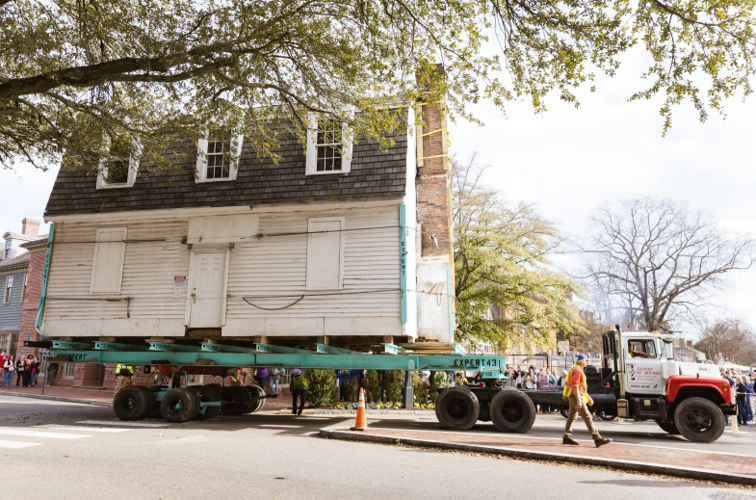
The Williamsburg Bray School building, likely the oldest existing schoolhouse for African Americans in the United States, was moved from the William & Mary campus to Colonial Williamsburg's Historic Area in 2023.
A lot has changed since 1926, but Colonial Williamsburg, thanks to a radical plan hatched by Goodwin, Rockefeller, and countless supporters over the past century, is positioned to stand as a bridge between the ideas that gave rise to the United States and the modern culture those complicated concepts begot. “Because of our scale, our trust, and our national reach,” Nagawiecki says, “we’re committed to playing a leadership role in the way civics and history are taught across the country.”
Colonial Williamsburg 100