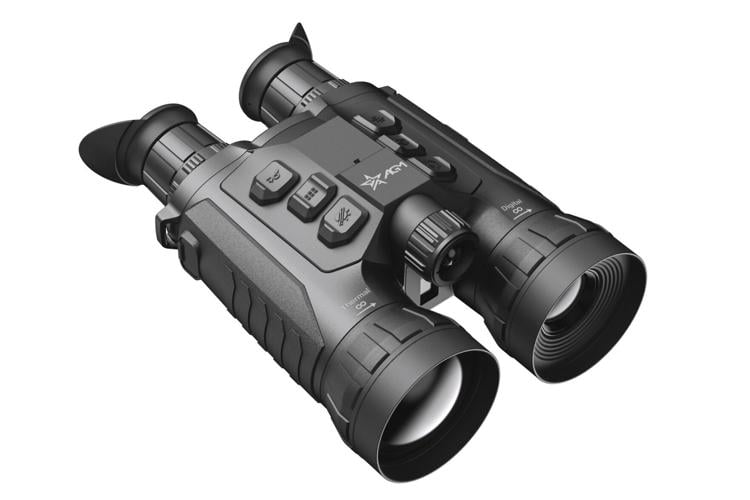


In the demanding fields of ecological monitoring, wildlife biology, and search and rescue operations, the ability to maintain depth perception in zero-light environments can be crucial. While monocular devices offer portability, they often limit the user's spatial awareness during extended observation periods. To overcome these limitations, modern optical engineering has focused heavily on dual-eyepiece architecture. For field specialists who require long-range tracking capabilities alongside natural field-of-view processing, deploying the advanced ObservIR thermal binoculars may provide an unmatched technical edge, redefining how professional nighttime surveillance is conducted.
By using two independent viewing channels, these high-end platforms may significantly reduce eye fatigue, potentially allowing operators to monitor expansive landscapes for hours without discomfort.
People are also reading…
Technical Advantages of Dual-Display Systems
The integration of dual-display thermal imaging into field operations may introduce several distinct advantages over traditional single-eyepiece setups.
- Natural Depth Perception: Stereoscopic viewing allows the human brain to calculate distances and terrain contours much more accurately in total darkness.
- High-Definition Thermal Sensors: Advanced core processors detect minute thermal variations, isolating camouflaged subjects against cold backgrounds.
- Extended Battery Efficiency: Modern power management systems ensure continuous operation throughout long nocturnal shifts in remote areas.
Real-World Field Applications
In practical scenarios, binocular thermal systems may offer unparalleled utility for environmental scientists and safety teams alike. For instance, biologists tracking nocturnal predators can observe natural behaviors from a safe distance without introducing disruptive artificial spotlights. Similarly, during critical search and rescue missions in rugged mountain terrain, operators can scan vast sectors through dense fog or thick foliage, potentially spotting the heat signatures of missing individuals within minutes rather than hours.
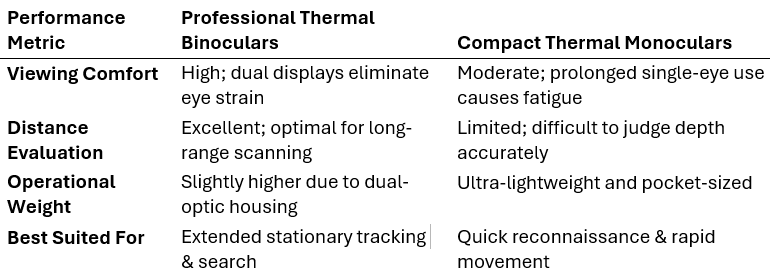
Operational Comparison: Binocular Thermal vs. Monocular Systems
Selecting the ideal framework depends on the duration of the deployment and the level of environmental complexity.
Conclusion
As the scope of professional outdoor operations expands, the reliance on high-performance thermal architecture becomes undeniable. Moving away from standard light-amplification tools toward sophisticated passive infrared technology may ensure that field teams remain efficient under any atmospheric conditions. Investing in specialized binocular thermal platforms may ultimately deliver superior situational awareness, verified operational safety, and absolute clarity when precision tracking is paramount.